 EN


From Approved Sample to Shipping Carton: Inside a Custom Sportswear QC Line
Approval is the easy part. A buyer looks at a sample, says yes, and the file moves to the cutting room. What happens after that rarely gets photographed: the same garment, rebuilt a few hundred times, checked one piece at a time by people who have already seen every way a seam can go wrong.
This is that stretch of the order, from the morning the approved sample lands on the floor to the evening the carton is sealed. It is also where the quality control question is settled, piece by piece. Sixty-eight seconds of it is on video below.
The approved sample goes on the wall, not on a shelf
The first thing that happens when an approved sample arrives is that it stops being a sample. It gets hung at eye level beside the tech pack, where the line can see both without walking anywhere. Anyone who needs to know what "correct" means that day looks at those two objects, not at a photo on a phone.
That is the entire quality control premise, and it is less glamorous than it sounds. The approved sample proves a garment can be built. The tech pack says what every graded size is supposed to measure. Inspection is the process of holding each piece up against both and refusing to average the answer.
The first piece off the line decides the run
Nobody waits until the end of the run to start quality control. The first piece off the line is measured against the approved sample and the chart before the line is allowed to keep moving: chest, body length, sleeve, hem, the marks that matter for that style. If it is off, the correction happens during quality control, while it costs one garment instead of four hundred.
This is the moment a buyer's approved sample earns its keep. A measurement chart is abstract; the first-off is the chart made physical. When the two disagree, the piece does not get waved through because the operator is experienced. It gets corrected, re-measured, and only then does the run continue into full inspection.
Shade: a stack lies, a palm does not
Two panels cut from the same roll can still come out different. That is ordinary in fabric handling, and almost invisible in a folded stack, which is exactly why so much shade trouble ships. It is also the quality control problem that hides best.
So the check is horizontal. Every piece goes down flat, side by side, and a hand passes over each one. Creases, tone shifts and faint marks surface under a palm in a way they never do in a pile. On a dark custom sportswear fabric, especially anything with a sheen, the difference between two panels can be half a tone and still be the first thing a customer sees in a photograph.
Seams get judged from the inside
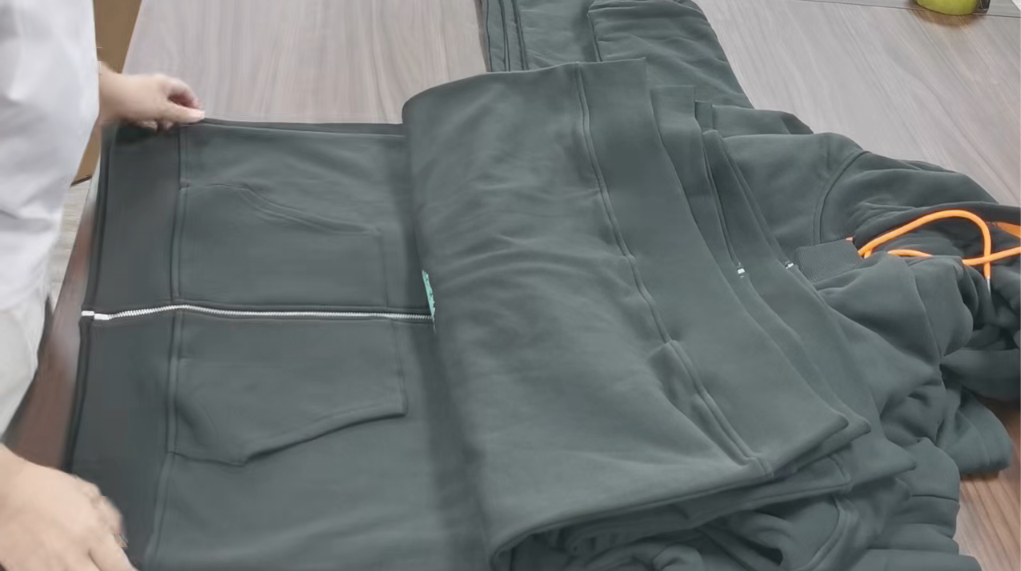
Loose threads get trimmed, but that is the shallow part of the inspection. Seams are turned and read from the inside, where the seam allowance lives and where the inspection actually starts: skipped stitches, a raw edge that was not finished, tension that looks fine on the face and ugly underneath.
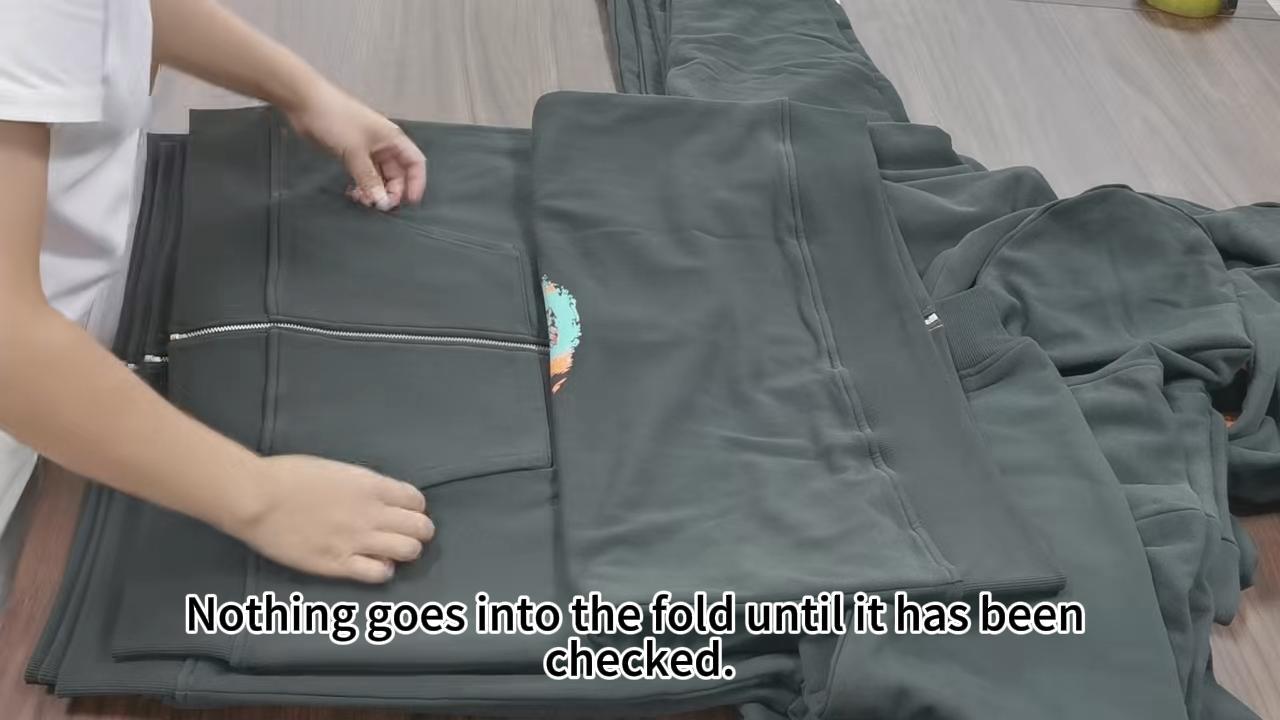
Stitching, finishing and the cut edge get run through the fingers, one piece, one seam. Nothing is folded until it has passed. A folded garment hides every one of those faults, which is why the fold is the last step of quality control and never the first.
Hardware has to be used, not admired
A pocket that looks right when it is empty can catch the moment it holds a phone. A zip that pulls smoothly once can bind on the third pass. Contrast stitching can sit a millimetre off and still look deliberate from across the room.
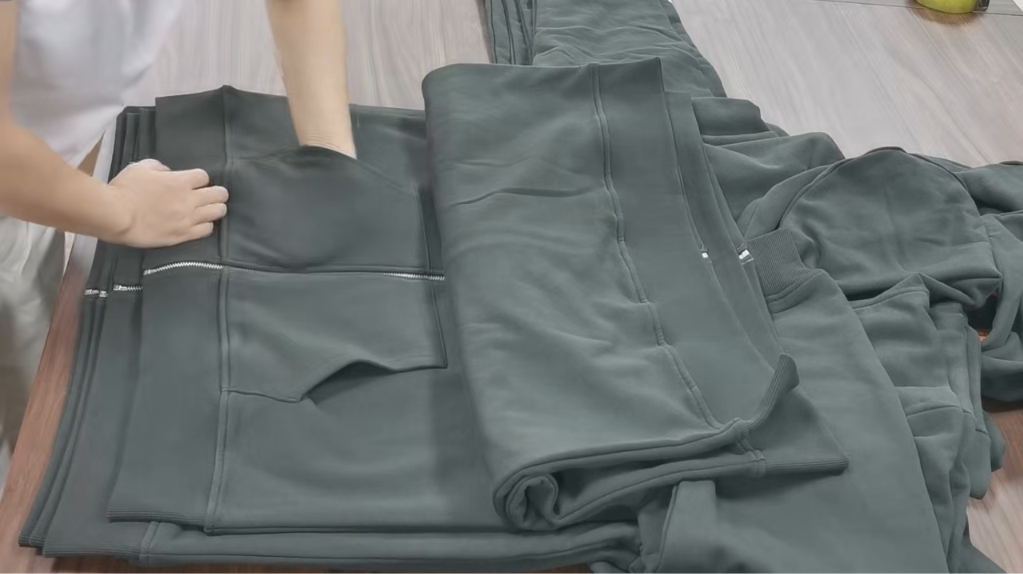
So the details get worked during inspection. Zips are cycled, pockets are opened and closed, flaps are lifted, bar tacks are pressed with a thumb. Every piece is inspected as a working object, not a display item. On a custom sportswear order, a buyer's first physical impression usually starts at the pocket, and a pocket that snags is a return that never needed to happen.
The tape measure is where shortcuts hide
Waistband, pocket, hem, body length: measured against the tech pack chart, on every size in the run, not one representative piece. A custom sportswear garment can be assembled beautifully and still be the wrong size, and that is the defect a buyer should never have to discover.
The tech pack does the arguing here. If the chart says one number and the table says another, the piece does not move forward on a verbal assurance. It moves forward on a second measurement.
There is a bench for the ones that fail
Nothing passes inspection because it is due to pass. A piece that fails goes to the rework bench, comes back, and gets checked again, often by a different pair of hands. The order ships when it clears, not when the calendar says so.
The quality control arithmetic is simple. A garment that fails in a buyer's warehouse costs freight, a delay and a replacement. A garment that fails on our table costs a rework and a second inspection. The second number is the one we would rather pay, every time.
A hundred pieces get the same check sheet
The question we hear most often is whether attention drops when the order does. It does not. A hundred custom sportswear pieces and ten thousand go through the same inspection, at the same effort per piece.
Small custom sportswear runs actually benefit from this. A short order is where a buyer is still learning the factory and its quality control, and a first run that holds its standard is usually what turns into a repeat programme.
What we need from you before quality control starts
Every inspection is only as strict as the reference it is measured against, and on this line that reference is the tech pack. Send a tech pack if you have one. If you do not, start with a reference image, the fabric direction, a colour reference, your size range and your quantity, and we will build the document with you.
If a sample already exists, photographs help more than descriptions: pocket construction, stitching, hem finish, the inside of a seam. Those four images tell us more about what you expect than a page of notes.
We will show you the approved sample, the measurement chart and the tech pack your order will be judged against, before anything is cut. If you also want to see the production side, cutting, sewing and finishing, ask and we will walk you through it.
Working on a custom sportswear order and want the same quality control applied to it? Send the tech pack, or tell us what you are building and we will tell you what is realistic.
Email: [email protected]
WhatsApp: +86 13995683615
Table of Contents
- From Approved Sample to Shipping Carton: Inside a Custom Sportswear QC Line
- The approved sample goes on the wall, not on a shelf
- The first piece off the line decides the run
- Shade: a stack lies, a palm does not
- Seams get judged from the inside
- Hardware has to be used, not admired
- The tape measure is where shortcuts hide
- There is a bench for the ones that fail
- A hundred pieces get the same check sheet
- What we need from you before quality control starts

